
Table of Contents
- Why Patio Paving Sinks: The Root Causes
- How Deep Should a Patio Sub-Base Be
- Compacting a Patio Sub-Base: The Critical Step
- Patio Drainage Solutions to Prevent Water Damage
- Installing Patio Paving Edge Restraints Correctly
- Material Selection for Stability and Longevity
- Best Practices During Installation
- Conclusion
- Frequently Asked Questions
Last Updated: 18 October 2026
Why Patio Paving Sinks: The Root Causes
Patio paving sinks when the ground beneath it fails to support the weight of the materials and foot traffic above it. This isn’t a flaw in the paving itself, it’s almost always a problem with what lies underneath.
The most common culprit is inadequate sub-base preparation. Soil shifts, compresses unevenly, and settles over time when it hasn’t been properly compacted. Water pooling beneath the patio accelerates this process dramatically. Frost heave in winter can also lift and destabilise paving, particularly in areas with clay-heavy soil.
Poor drainage is another major factor. When water cannot escape from under the patio, it saturates the soil, weakens its load-bearing capacity, and creates voids as the soil settles. Tree roots growing beneath the surface can also cause upheaval and subsidence. The material you choose matters too, some paving types are more forgiving of minor ground movement than others.
Understanding these causes is the first step to preventing patio paving from sinking. The good news is that most of these problems are entirely preventable with proper planning and installation technique.
How Deep Should a Patio Sub-Base Be
A patio sub-base should typically be 100-150 mm deep for residential applications, depending on the soil type and expected use. This depth provides enough material to absorb ground movement and distribute the weight of the paving evenly.
For heavier-use areas or poor soil conditions, go deeper. Clay soils or areas with high water tables may need 150-200 mm of sub-base. The key is having enough compacted material to create a stable platform. Skimping on depth is one of the fastest ways to end up with sinking patio paving.
The sub-base should sit on clean, level ground. Remove any turf, organic matter, or loose soil first. The base layer typically consists of:
- Well-graded crushed stone or recycled aggregate
- Angular material that locks together when compacted
- Proper drainage properties to allow water to escape
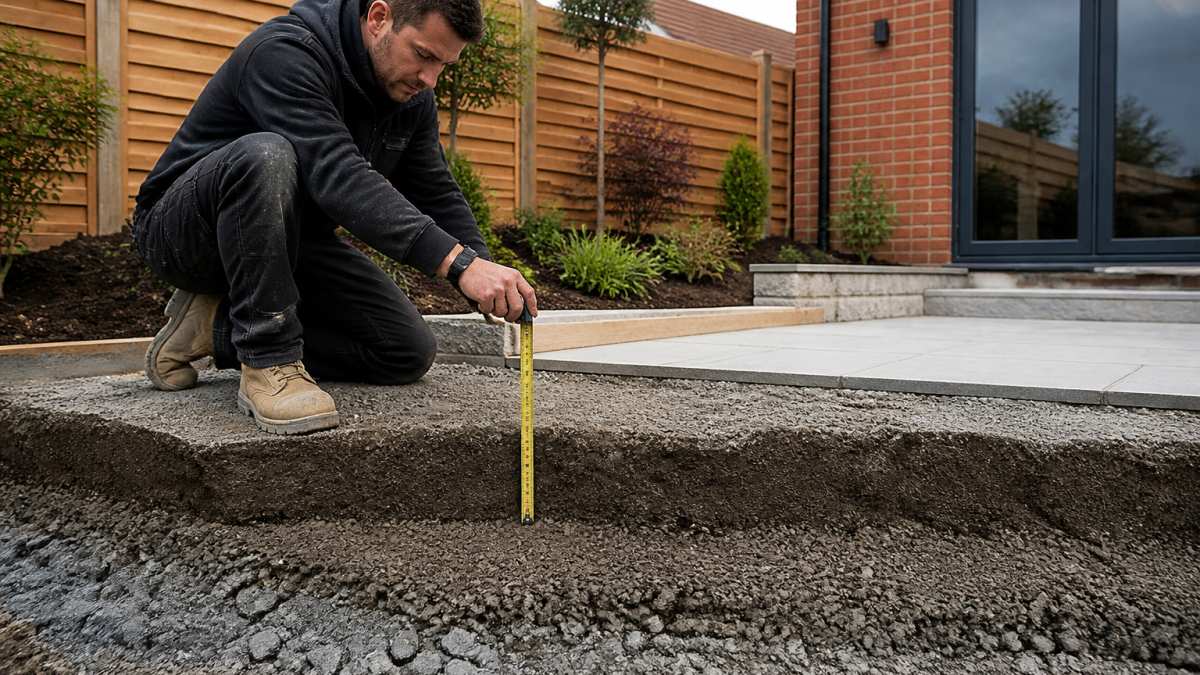
After laying the aggregate, you’ll add a sand layer (25-50 mm) on top to create a smooth, level bed for your paving. The total construction depth from finished ground to the top of your paving will be roughly 175-250 mm, depending on paving thickness.
Compacting a Patio Sub-Base: The Critical Step
Compacting the sub-base is where most DIY installations fall apart. You cannot simply spread aggregate and lay paving on top, the material must be compressed firmly to eliminate air voids and create a solid, stable foundation.
Use a plate compactor or vibrating tamper to compress the sub-base in layers. Compact in 50 mm lifts, not all at once. Each layer should be compacted until it no longer shifts or settles noticeably under the machine’s weight. This typically requires 3-5 passes with a plate compactor.
The compaction process matters because:
- It locks aggregate particles together
- It reduces future settlement and movement
- It creates a uniform, level surface
- It improves drainage by allowing water to flow through rather than pool
Test the compaction by walking across the area. If the ground feels springy or gives way under your weight, it needs more compaction. A properly compacted sub-base should feel solid and stable underfoot.
Many homeowners assume their installer has done this properly. Ask to see the compaction work in progress. Professional contractors use calibrated equipment and follow structured compaction protocols to ensure preventing patio paving from sinking starts at this stage.
Hire a contractor with proper compaction equipment. Hand-tamping or light vibrating tools are rarely sufficient for a truly stable base. The investment in professional-grade compaction pays for itself by avoiding costly repairs later.
Patio Drainage Solutions to Prevent Water Damage
Water is the enemy of a stable patio. Once water gets trapped beneath the paving, it weakens the soil, promotes frost heave, and accelerates subsidence. Effective Drainage & Groundworks solutions keep water moving away from the patio foundation.
The first line of defence is slope. Your patio should fall away from the house at a gradient of roughly 1:80 to 1:100 (about 10-15 mm per metre). This gentle slope directs surface water away without being noticeable to the eye.
Sub-base drainage is equally important. Use a permeable sub-base material that allows water to drain through it. Avoid fine materials like sand or silt in the base layer, these trap water. Crushed stone and recycled aggregate allow water to percolate downward.
For areas with poor natural drainage or high water tables, consider installing a perforated land drain beneath the sub-base. This collects water and directs it away from the patio to a soakaway or surface water outlet. Professional drainage solutions often include:
- Perforated land drain pipe laid at the base
- Geotextile membrane to prevent soil migration
- Gravel-filled trench around the drain
- Connection to a soakaway pit or drainage system
Without proper drainage, even a well-compacted base will eventually fail as water accumulates and destabilises the soil below.
Installing Patio Paving Edge Restraints Correctly
Edge restraints prevent your patio from spreading outward under load. Without them, the outer edges of the paving shift, creating gaps and uneven surfaces. Over time, this movement destabilises the entire structure.
Proper patio paving edge restraints should be:
- Rigid and firmly anchored to the ground
- Installed before laying the paving
- Set at the correct height (level with or slightly below the finished paving surface)
- Spaced appropriately to resist outward pressure
Common edge restraint options include concrete kerbs, metal edging, or timber boards. Concrete kerbs are the most durable for preventing patio paving from sinking in the long term, as they resist rot and movement.
Install edge restraints by:
- Excavating a trench along the patio perimeter
- Setting the restraint in a concrete foundation (100 mm minimum)
- Backfilling and compacting soil behind the restraint
- Ensuring the top is level and at the correct height
Many installations fail because the edge restraints are set too shallow or not bedded firmly enough. They shift under lateral pressure, and the patio follows. Professional installations use deep foundations and proper compaction behind the restraints.
Material Selection for Stability and Longevity
The paving material you choose affects how well your patio resists movement and settling. Some materials are more forgiving than others.
Natural stone offers excellent stability because its weight and density help lock it in place. Thicker slabs (40 mm or more) are more rigid and less prone to cracking if minor settling occurs. Natural stone also develops a patina over time that many homeowners prefer.
Porcelain paving is extremely rigid and dense, making it ideal for preventing patio paving from sinking. It resists frost damage and moisture absorption far better than many alternatives. Porcelain is an excellent choice for high-value residential projects where long-term durability matters.
Concrete flags are affordable but more susceptible to cracking if the base settles unevenly. They’re suitable for well-prepared bases but less forgiving of imperfect installation.
Brick and block paving allow for flexibility, individual units can adjust to minor ground movement without cracking the entire surface. However, they require careful edge restraint and proper compaction to prevent individual units from shifting.
For larger, higher-value gardens where stability is paramount, Porcelain & Natural Stone Paving are superior choices. They’re less forgiving of poor base preparation, but when the foundation is done correctly, they provide exceptional longevity.
Thicker, denser materials (porcelain, quality natural stone) are more stable on well-prepared bases. Thinner or more flexible materials require even more meticulous foundation work to prevent movement.
Best Practices During Installation
Preventing patio paving from sinking begins the moment work starts on site. Professional installation follows a structured sequence that eliminates common mistakes.
Site preparation must be thorough. Remove all turf, vegetation, and soft organic material. Level the ground and remove any loose soil. This step is often rushed, but it sets the tone for everything that follows.
Sub-base installation should be done in layers with compaction between each one. Don’t skip this, it’s the foundation of a stable patio. Verify that your contractor is using proper compaction equipment and technique.
Drainage setup needs to happen before the sand layer is laid. Install any land drains, check that the slope is correct, and confirm that water will flow away from the patio, not towards it.
Sand bedding should be level and evenly spread. Use a straightedge to check. Inconsistent bedding thickness leads to uneven settling and cracking.
Paving installation should follow the sub-base exactly. Don’t force paving to fit, if it doesn’t sit naturally, the base may be uneven. Tap each piece gently to bed it into the sand.
Pointing and finishing should use quality mortar or jointing compound. Proper jointing locks the paving together and prevents individual units from shifting.
We manage every phase of the installation process to ensure the foundation is absolutely solid before paving goes down. This attention to detail is what separates patios that last decades from those that fail within a few years.
Conclusion
Preventing patio paving from sinking is entirely achievable when you understand the causes and follow proven installation practices. The key is treating the foundation with the same care and attention you’d give the finished paving itself.
A properly prepared sub-base, effective drainage, correct edge restraints, and careful material selection work together to create a patio that stays level and stable for years to come. When you’re planning a patio project, ask your contractor about their sub-base preparation methods, compaction protocols, and drainage solutions. These details separate quality work from shortcuts.
Finescape Landscaping & Paving Ltd specialises in Patios & Paving and complete garden transformations across the region. We handle everything from initial site assessment through design and full construction, with a focus on proper groundworks and drainage that ensure your patio remains stable and beautiful. Contact us today to discuss your patio project and get a professional assessment of your site conditions.
Frequently Asked Questions
Why does patio paving sink?
Patio paving sinks when the sub-base is inadequately prepared, poorly compacted, or insufficient in depth. Water infiltration, frost heave in winter, and soil movement all contribute to subsidence. Without proper edge restraints, paving can shift laterally as well. The most common cause is rushing the groundwork preparation, cutting corners on sub-base depth or compaction leads to settlement over months or years as the ground beneath compresses under the weight of the patio.
How deep should a patio sub-base be?
A patio sub-base should typically be 100-150 mm deep for residential applications, depending on soil type and expected load. Poor-draining soils may require deeper preparation. The sub-base consists of well-compacted stone aggregate, usually in two layers: a coarser base layer and a finer bedding layer on top. Proper depth is essential for load distribution and preventing patio paving from sinking as ground conditions change seasonally.
What’s the difference between a patio that sinks and one that stays level?
The difference lies in ground preparation. A stable patio has a properly excavated, compacted sub-base of adequate depth, good drainage to prevent water pooling beneath, and edge restraints to prevent lateral movement. A patio that sinks was likely laid on shallow, uncompacted soil or a thin sub-base. Professional installation includes systematic compaction in layers to ensure long-term stability.
Can poor drainage cause patio paving to sink?
Yes. Water trapped beneath a patio weakens the sub-base and soil, causing settlement and subsidence. Patio drainage solutions include installing a permeable base layer, ensuring adequate fall for surface water runoff, and using edge drains or French drains if the site is particularly wet. In areas with poor natural drainage, a geotextile membrane between the sub-base and soil can prevent upward water migration while allowing downward drainage.
