
Table of Contents
- How Long Does It Take to Lay a 20m2 Patio? The Short Answer
- A Stage-by-Stage Timeline for Laying a 20m2 Patio
- Factors Affecting Patio Laying Time
- Patio Site Preparation Steps That Decide Your Timeline
- How Long for Patio Mortar to Set Before You Can Use It
- How to Speed Up Your Patio Installation
- Conclusion
- Frequently Asked Questions
Last Updated: October 1, 2026
How Long Does It Take to Lay a 20m2 Patio? The Short Answer
Most professional teams need three to five working days to lay a 20m2 patio. That covers excavation, sub-base, paving and pointing.
But here’s what most guides get wrong: the paving itself is the quick part. It takes roughly a day. The other four days go on ground preparation, and that is where your timeline is really decided.
This guide breaks down how long it takes to lay a 20m2 patio stage by stage. You’ll see where the hours actually go, what slows a job down, and how to speed things up without cutting corners.
A Stage-by-Stage Timeline for Laying a 20m2 Patio
A typical 20m2 patio splits into four stages. Site preparation takes the longest. Paving is the fastest. Here’s how the days usually fall.
|
Stage |
Typical Duration |
What Happens |
|---|---|---|
|
Site preparation |
1-1.5 days |
Clear, dig, level |
|
Sub-base and edging |
1-1.5 days |
Hardcore, compact, edges |
|
Laying the paving |
0.5-1 day |
Cut and lay slabs |
|
Pointing and finishing |
0.5-1 day |
Joints, clean, cure |
Add a day if access is tight or the ground is heavy clay.
Stage 1: Site Preparation
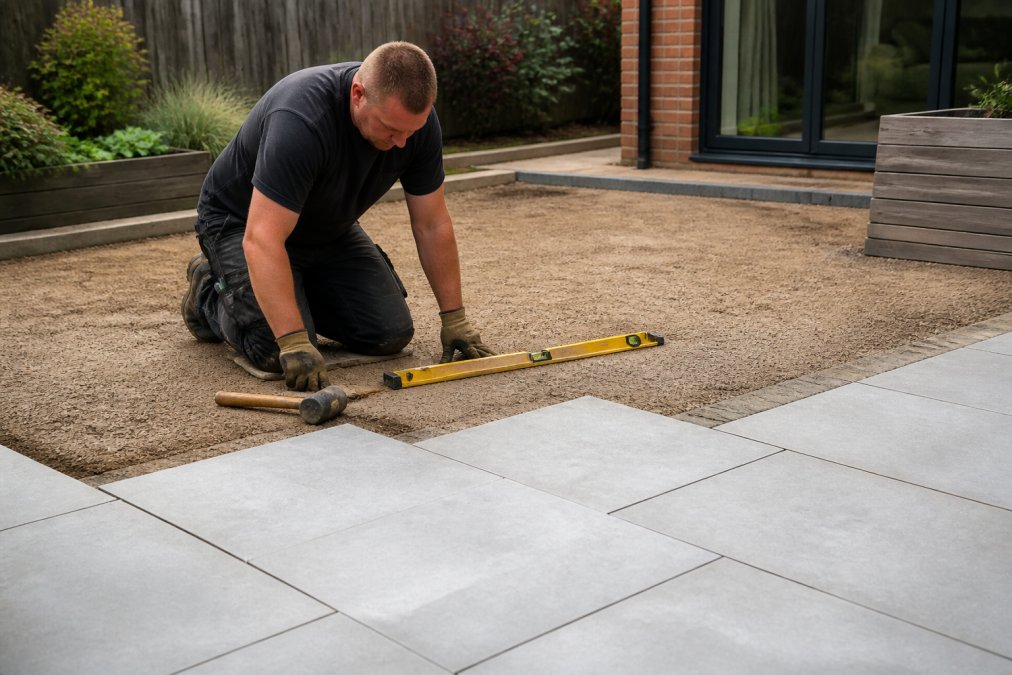
Site preparation is the slowest stage, and the one that decides whether your patio lasts. Teams dig out to the right depth, then level and compact the ground.
For a 20m2 area, expect one to one-and-a-half days. Old patio removal, tree roots or drainage issues push it longer. Skip this stage and the slabs will sink within a year.
Stage 2: Sub-base and Edging
The sub-base is the compacted layer of hardcore that carries the weight of the patio. A common approach is 100mm of compacted hardcore for a footpath, more where cars park.
This stage takes another one to one-and-a-half days. Edging goes in at the same time. It holds the slabs in place and stops the patio spreading.
Stage 3: Laying the Paving
Laying the paving is the fastest stage, often half a day to a full day for 20m2. Slabs are bedded onto a mortar mix and tapped level.
Cuts around edges and corners add time. So does a complex pattern. A simple grid of large porcelain slabs moves quickly. A small-format natural stone in a random pattern does not.
Stage 4: Pointing and Finishing
Pointing fills the joints between slabs. It takes half a day to a full day, depending on joint width and the mix used.
Finishing covers cleaning, checking levels and tidying the site. Then the patio needs to cure before you walk on it. More on that below.
Factors Affecting Patio Laying Time
Several factors move your timeline by a day or more. The big ones are ground conditions, access and weather.
- Ground type: Heavy clay or soft soil needs more digging and a deeper sub-base.
- Access: If a digger or wheelbarrow can’t reach the garden easily, everything slows.
- Drainage: Poor drainage may need a soakaway or channel, adding time.
- Slab choice: Large porcelain lays faster than small natural stone.
- Weather: Heavy rain stops digging and can wash out a fresh sub-base.
- Pattern: A simple grid is quicker than herringbone or random layouts.
Two patios of the same size can differ by two days on ground conditions alone.
Patio Site Preparation Steps That Decide Your Timeline
Good patio site preparation steps are what separate a patio that lasts from one that shifts. Here’s the order professionals follow.
- Mark out the patio area and check levels
- Remove turf, old paving and debris
- Dig out to the required depth
- Compact the exposed ground
- Add and compact the hardcore sub-base in layers
- Check falls so water runs away from the house
- Set the edging on a concrete bed
- Bed and level the slabs
How Long for Patio Mortar to Set Before You Can Use It
Patio mortar needs about 24 to 48 hours to set enough for light foot traffic. Full strength takes longer.
For a standard sand and cement mix, keep off the joints for at least a day. Wait two to three days before moving furniture onto it. Full curing takes around 28 days, though the patio is usable well before then.
Weather matters here. Cold, wet conditions slow the set. Hot, dry weather speeds it up but can dry the mortar too fast. A resin-based jointing compound often sets faster than cement, which can shorten the wait.
How to Speed Up Your Patio Installation
You can shave a day off without cutting corners. Most of the gains come from preparation, not rushing the paving.
- Clear the site before the team arrives
- Choose a simple layout and larger slabs
- Sort access so materials reach the garden easily
- Order all materials in advance
- Book in a dry spell if you can
Hiring a team that handles design, groundworks and paving under one roof saves the handover gaps between trades.
Conclusion
A 20m2 patio takes most teams three to five working days, and the ground decides the rest. Rushing the base is the fastest way to a patio that fails.
At Finescape Landscaping & Paving Ltd, we manage the whole job from design to completion. That includes groundworks, drainage, porcelain and natural stone paving, and the finishing touches. One team, one plan, no gaps between trades.
Get started with Finescape Landscaping & Paving Ltd and lay a patio that stays level for years. Contact us today for a quote.
Frequently Asked Questions
How many days does it take to lay a 20m2 patio?
For a straightforward 20m2 patio on level ground with good access, most professional teams complete the work in three to five working days. That covers excavation, sub-base, laying and pointing. If the ground needs significant levelling, drainage work, or if you choose natural stone over porcelain, expect five to seven days. Weather also plays a part, as rain can halt excavation and pointing.
Does the type of paving slab affect installation time?
Yes, it does. Porcelain slabs are uniform in thickness and calibrated, so they lay quickly with consistent joints. Natural stone such as sandstone or limestone varies in thickness and edge, which means more time spent sorting, adjusting and achieving an even surface. Larger format slabs cover more area per piece but are heavier to handle and need more careful bedding.
Do I need to account for patio site preparation steps in the timeline?
Absolutely. Site preparation typically takes one to two days on its own, and it is the stage that determines how long the finished patio lasts. Excavating to the right depth, laying and compacting an MOT Type 1 sub-base, and setting levels all happen before a single slab goes down. Rushing this stage is the most common reason patios sink or shift within a year.
How long should I wait before walking on a new patio?
It depends on the pointing method. With traditional sand and cement mortar, stay off the surface for at least 24 to 48 hours, and avoid heavy furniture or planters for around three to five days. Resin-based jointing compounds usually set faster, often within 12 to 24 hours, but check the manufacturer’s guidance. Full curing takes longer, so keep heavy loads off for at least a week.
