
Table of Contents
- What You’ll Need Before You Start
- Step 1: Assess the Slope and the Soil
- Step 2: Garden Slope Drainage Solutions That Work
- Step 3: How to Terrace a Garden Slope
- Step 4: Erosion Control Matting for Slopes
- Step 5: Best Plants for a Sloping Garden
- Step 6: How to Stabilise a Garden Slope: Common Mistakes to Avoid
- When to Call a Professional to Stabilise a Garden Slope
- Frequently Asked Questions
Last Updated: October 17, 2026
What You’ll Need Before You Start
A sloping garden can be stabilised without a retaining wall, but only if you work with the slope rather than against it. The goal is to slow water down, hold soil in place, and spread the load across the surface. This guide from Finescape Landscaping & Paving Ltd walks through the practical steps we use on sloping sites.
Before you lift a spade, gather the basics:
- Spade and fork for testing soil depth
- Spirit level and tape measure to work out the gradient
- Ground-cover membrane or erosion matting for bare soil
- Gravel or bark mulch for surface protection
- Sturdy stakes and timber if you plan to build low terraces
- Plants suited to slopes (more on these in Step 5)
You do not need heavy machinery for a gentle slope. Steeper ground, or a slope close to a building, needs proper assessment first.
Never start digging on a slope without checking where water currently runs. Cut into the wrong spot and you can redirect runoff towards your house or a neighbour’s boundary.
Step 1: Assess the Slope and the Soil
Gradient decides everything. Measure the rise over a set distance to get a rough percentage. A slope under about 10% is gentle and easy to manage. Anything above roughly 20% needs more thought.
Next, test the soil. Push a spade in and turn a slice over.
- Sandy soil drains fast but washes away easily.
- Clay soil holds water and can slump when saturated.
- Loam is the easiest to work with.
A simple ribbon test tells you a lot. Roll damp soil between your fingers; a long ribbon means high clay content. That matters because clay slopes need better drainage before you plant anything.
Step 2: Garden Slope Drainage Solutions That Work
Water is the real enemy of a slope. Garden slope drainage solutions should move water away before it saturates the soil and triggers movement.
The most reliable options are:
- A shallow swale (a planted dip) running across the slope to catch runoff.
- French drains filled with gravel and pipe to carry water to a soakaway.
- Permeable surfaces such as gravel or stepping stones instead of solid paving.
- Mulch and ground cover to slow surface flow.
Direct water to a soakaway or a suitable drainage point, never towards a building. If the slope sits near a structure, get the levels checked properly.
Step 3: How to Terrace a Garden Slope
Terracing breaks a long slope into shorter, flatter sections. It is the most effective way to terracing a garden slope without a full retaining wall, using low timber or stone edges instead.
Keep each terrace shallow, and set the edge no higher than a couple of steps. Line the front of each level with timber, brick or stone to hold the soil. Add a gap or drainage channel behind the edge so water can escape.
- Mark out level lines with stakes and string first.
- Dig back into the slope, not out from it.
- Compact the base of each edge before backfilling.
- Plant or mulch each terrace as soon as it is finished.
Low terraces also make the garden easier to use, which is often the real win.
Step 4: Erosion Control Matting for Slopes
Erosion control matting for slopes holds bare soil in place while roots establish. It is a simple, low-cost fix for ground you cannot plant straight away.
Biodegradable jute or coir matting is the usual choice for gardens. Lay it over prepared soil, pin it down, and cut a slit to plant through. The matting breaks down as plants take over.
For steeper ground, a heavier geotextile mesh gives more grip. Always lay matting following the slope, not across it, and pin the top edge firmly.
Water the soil before laying matting so it sits flush. Dry, loose soil lets the matting shift and defeats the purpose.
Step 5: Best Plants for a Sloping Garden
The best plants for a sloping garden are deep-rooted, drought-tolerant and happy on free-draining ground. Roots are what hold a slope together long term.
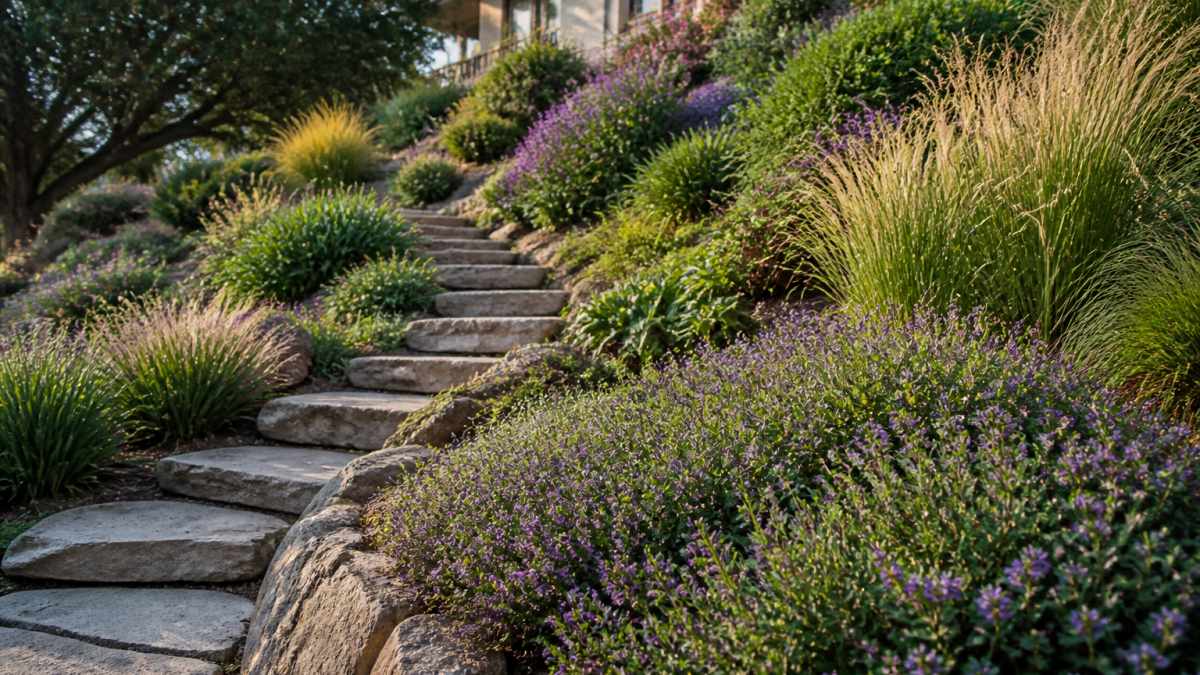
Good choices include:
- Ground cover: creeping thyme, sedum, and alpine plants.
- Shrubs: lavender, cotoneaster, and low-growing hebes.
- Grasses: ornamental grasses that knit the soil together.
Plant in layers and avoid bare patches. Group plants so roots overlap, and mulch between them to protect the surface until they fill in.
Step 6: How to Stabilise a Garden Slope: Common Mistakes to Avoid
Most slope failures come down to a handful of avoidable errors. Getting these right is the difference between a stable garden and one that slumps after heavy rain.
- Ignoring drainage. Water left to pool will always win.
- Leaving soil bare. Bare earth washes away fast.
- Building edges too tall. High, unsupported edges topple.
- Planting the wrong species. Thirsty plants on free-draining slopes struggle.
- Skipping the base. Uncompacted terrace edges sink.
To stabilise a garden slope properly, fix water first, then structure, then planting. Doing it in that order saves rework.
When to Call a Professional to Stabilise a Garden Slope
Some slopes need more than matting and plants. Call in a professional when the ground is steep, when a slope sits close to a building or boundary, or when you see cracks, bulging or movement.
That is where Finescape Landscaping & Paving Ltd comes in. We handle drainage and groundworks, brickwork and low retaining structures, turfing and planting as part of a full garden design. We manage the project from design through to completion, so the slope is dealt with as one system rather than a patch.
If you are unsure whether your slope is safe to tackle yourself, get it assessed before you dig.
Frequently Asked Questions
How can I stabilise a garden slope without a retaining wall?
You can stabilise a slope by improving drainage, terracing shallow steps, laying erosion control matting and planting deep-rooted ground cover. These methods work together to slow water runoff and hold the soil in place. For slopes steeper than about 1 in 4, or where soil is already slipping, a professional assessment is wise. A landscaper can check soil stability and recommend the right combination of drainage and planting for your garden.
What plants are best for holding soil on a slope?
Choose deep-rooted, low-maintenance plants that knit the soil together. Good options include cotoneaster, vinca minor, hardy geraniums, ornamental grasses and ferns. Shrubs like berberis and euonymus also work well. Plant in autumn or spring so roots establish before heavy rain. Avoid shallow-rooted bedding plants, which do little to prevent erosion on a sloping garden.
How do I stop soil washing down a garden slope?
Slow the water before it gathers speed. Install a French drain or a shallow swale across the slope, spread erosion control matting on bare soil and plant dense ground cover. Avoid leaving soil bare over winter. Direct downpipes and surface water into a drainage channel rather than letting it run down the slope. These garden slope drainage solutions reduce runoff and keep soil where it belongs.
Can I use terraces or steps without a retaining wall?
Yes. Shallow terraces and steps can be formed with timber edging, gravel or planted banks rather than block walls. Keep each terrace low, ideally under 30cm, and add a slight backward slope so water soaks in rather than running off. For steeper drops, terraces work best combined with drainage and planting. If the slope is very steep, a professional can advise on safe terracing heights.
A sloping garden that keeps shifting is frustrating, and it rarely fixes itself. The right drainage, structure and planting turn an awkward slope into usable, stable ground. Finescape Landscaping & Paving Ltd designs and builds complete garden transformations, including drainage and groundworks, brickwork and retaining walls, and turfing and planting. Get started with Finescape Landscaping & Paving Ltd and build a slope that holds for good.
