
Table of Contents
- Why Garden Wall Drainage Decides Whether Your Wall Stands
- How Water Pressure Builds Up Behind a Garden Wall
- What Happens When There Is No Drainage Behind a Retaining Wall
- Choosing the Right Retaining Wall Drainage Pipe
- Weep Holes in Retaining Walls: Small Openings, Big Job
- Signs of Retaining Wall Failure to Watch For
- Where the Water Should Go Once It Leaves the Wall
- Frequently Asked Questions
Last Updated: October 16, 2026
Why Garden Wall Drainage Decides Whether Your Wall Stands
Water is the single biggest threat to any retaining wall. This is why garden walls need structural drainage: without a way for groundwater to escape, pressure builds up behind the brickwork until the wall cracks, leans, or collapses. At Finescape Landscaping & Paving Ltd, we build retaining walls and drainage systems as one job, never two.
Structural drainage is the system of pipes, gravel, and outlets that collects groundwater behind a wall and carries it away before pressure can build. Get it right and a wall can last decades. Skip it and even the best brickwork will fail.
Below, we explain how water pressure works, what happens when drainage is missing, and how to spot a wall in trouble before it costs you a rebuild.
A retaining wall holds back two things: soil and water. Most failures come from the water, not the soil.
How Water Pressure Builds Up Behind a Garden Wall
Soil looks solid, but it soaks up rainfall like a sponge. Every downpour adds water to the ground behind your wall, and that water has to go somewhere.
When it cannot drain away, it saturates the soil and pushes outward against the wall. This is called hydrostatic pressure, and it grows fast. Wet soil can weigh far more than dry soil, and the force increases with depth. The base of the wall takes the worst of it.
A wall built to hold back dry earth may be perfectly sound. The same wall holding back saturated ground is under a completely different load.
- Rainfall soaks into the ground behind the wall
- Water cannot escape if there is no drainage path
- Saturated soil becomes heavier and pushes harder
- Pressure peaks at the base of the wall, where failure starts
What Happens When There Is No Drainage Behind a Retaining Wall
Without drainage behind a retaining wall, water has nowhere to go but through the wall itself. It finds the weakest points: mortar joints, cracks, and the base.
The first sign is often damp patches or white staining on the brickwork. Then comes movement. The wall may lean, bow, or develop a visible bulge. In the worst cases, the whole structure gives way.
The damage is not just to the wall. Waterlogged ground can undermine patios, driveways, and paths nearby. Fixing the wall alone rarely solves the problem if the water still has nowhere to drain. That is why we treat retaining walls and groundworks and drainage guidance from the UK’s planning portal as a single design decision, not two separate jobs.
Choosing the Right Retaining Wall Drainage Pipe
The right retaining wall drainage pipe is a perforated or slotted pipe laid in a gravel-filled trench at the base of the wall. Water enters through the slots, flows along the pipe, and exits at a safe outlet point.
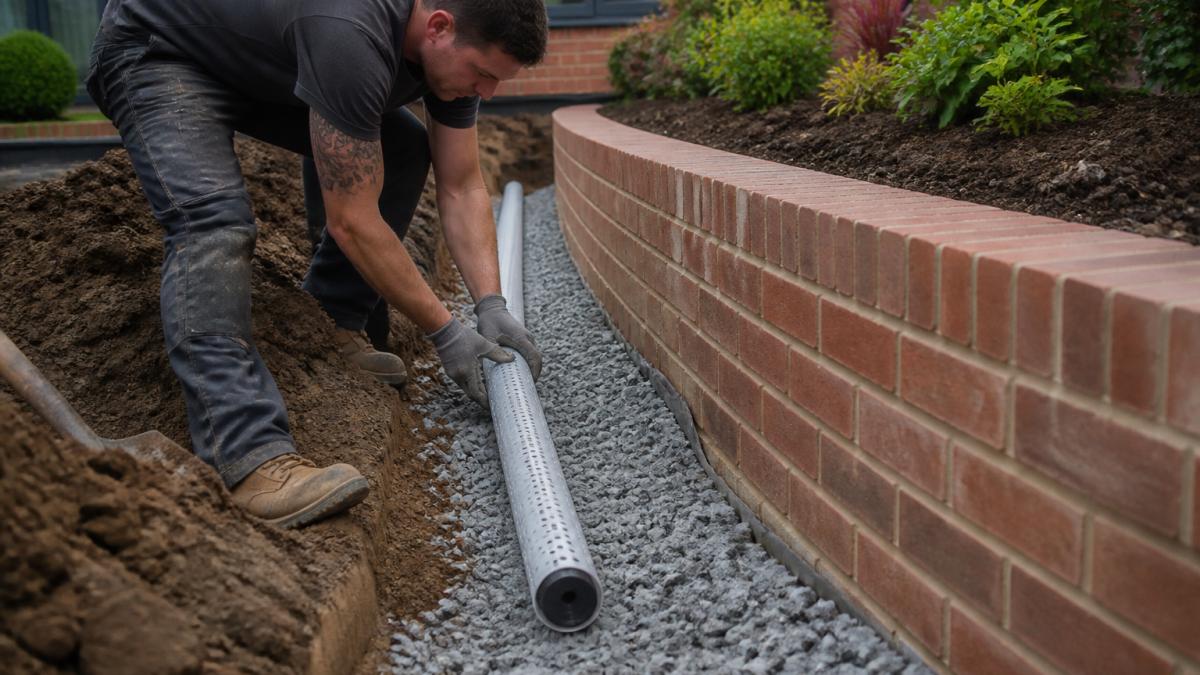
Getting the details right matters more than the pipe itself:
- Pipe type: rigid perforated pipe or flexible slotted pipe, both widely used
- Surround: wrap the pipe in gravel, not soil, so water flows freely
- Geotextile fabric: stops fine soil washing into the gravel and clogging it
- Fall: the pipe needs a gentle slope so water runs toward the outlet
- Outlet: it must discharge somewhere safe, never back into the wall
A common mistake is laying the pipe with no fall. Water sits in the trench instead of draining, and the system does nothing.
Weep Holes in Retaining Walls: Small Openings, Big Job
Weep holes in retaining walls are small openings built into the wall itself to let trapped water escape. They are a simple backup to the main drainage pipe, not a replacement for it.
They are typically set just above ground level on the lower side of the wall. Spacing them evenly along the length keeps water from pooling in one spot.
Weep holes need to stay clear. If they clog with soil or debris, they stop working, and pressure builds again. A wall that relies on weep holes alone, with no pipe behind it, is a wall waiting for trouble.
Blocked weep holes are one of the most common causes of damp brickwork. If water stains appear low on a wall, check the weep holes first.
Signs of Retaining Wall Failure to Watch For
Catching the signs of retaining wall failure early can save you a full rebuild. The warning signs are usually visible long before a wall collapses.
Look for these:
- Leaning or bowing: the wall tilts away from the soil it holds
- Cracks: horizontal cracks are a serious warning; vertical ones need checking too
- Bulging: a section pushes outward, often after heavy rain
- Damp or white staining: water is moving through the brickwork
- Sinking or shifting: the base moves, or the ground behind it drops
- Water pooling: puddles at the foot of the wall after rain
Any one of these means water is winning. Two or more together means the wall needs attention now.
Where the Water Should Go Once It Leaves the Wall
Water leaving the wall must go somewhere safe, or the problem simply moves. The outlet is the part most often overlooked.
A well-designed system connects the drainage pipe to a soakaway, a drainage channel, or an existing surface water drain. The choice depends on your ground, your levels, and where water can legally discharge.
Poor outlets cause their own problems:
- Water dumped at the foot of the wall soaks straight back in
- Water sent toward a neighbour’s land can cause a dispute
- Water with nowhere to go floods patios, lawns, or driveways
At Finescape Landscaping & Paving Ltd, we design the outlet as part of the whole scheme, so water leaves the wall and never returns. For larger gardens, this often means combining retaining wall drainage with wider guidance on managing surface water from the UK’s environment regulator and groundworks planning.
If your ground is heavy clay, a soakaway may not work well. Clay holds water instead of letting it drain, so a piped outlet is often the better route.
A retaining wall is only as good as the drainage behind it. Water pressure is patient, and it will find every weakness in a wall that gives it nowhere to go.
At Finescape Landscaping & Paving Ltd, we design and build retaining walls, brickwork, and drainage as one complete job. From landscape design and garden transformations to groundworks and porcelain paving, we manage the whole project from first drawing to final finish.
Get started with Finescape Landscaping & Paving Ltd and build a wall that stands for decades, not seasons.
Frequently Asked Questions
Why does a retaining wall need drainage?
A retaining wall holds back soil, and that soil holds water. After heavy rain, saturated ground pushes hard against the wall from behind. Without garden wall drainage, that pressure has nowhere to go and builds until the wall cracks, leans or collapses. Drainage gives the water a controlled route out, so the wall only carries the weight of the soil rather than soil plus trapped water.
What happens if a retaining wall has no drainage?
Water collects behind the wall and creates hydrostatic pressure, which is far greater than the soil alone would exert. You will usually see the warning signs first: mortar joints opening, a slight lean, or damp patches on the face. Left alone, the wall can bulge and eventually fail, and repairs often mean rebuilding the structure rather than a simple fix.
What drainage should go behind a retaining wall?
The standard build-up is a gravel backfill layer immediately behind the wall, a perforated retaining wall drainage pipe running along the base, and a geotextile membrane to stop fine soil clogging the gravel. Weep holes in retaining walls then let any remaining water escape through the wall face. All of it needs somewhere to discharge, such as a soakaway or existing drainage run.
How can you tell if a retaining wall drainage system is failing?
Watch for water pooling at the wall base after rain, damp or stained patches on the brickwork, soil washing out through the joints, and weeds or moss appearing in the weep holes. A wall that leans or shows stepped cracking is already in trouble. If any of these signs of retaining wall failure appear, get the drainage inspected before the movement gets worse.
