
Last Updated: November 21, 2026
Quick Summary
The top-rated contractors in Berkshire for a porcelain patio are chosen on ground preparation, drainage design and a written workmanship guarantee, not on price or brochures. Compare firms on itemised scope, porcelain experience, current public liability insurance and recent reviews that name the project type.
- Ask every firm for the same itemised quote covering excavation, sub-base, drainage, laying, jointing and waste removal.
- Check the insurance certificate is current and names the firm you are contracting with.
- Look for reviews from the last twelve months that mention ground preparation, drainage and the fall away from the house.
- A typical porcelain patio schedule runs from site set-up through jointing and finishing over several days.
- Request two recent referees with patios comparable to yours and ask how defects in the first year were handled.
Table of Contents
- What Top-Rated Porcelain Patio Installers in Berkshire Get Right
- Porcelain Patio Installers Berkshire: How to Compare Local Firms
- Porcelain Patio Preparation and Drainage: The Part That Decides Longevity
- Landscaping Contractor Reviews and Portfolios: What Actually Counts
- Porcelain Patio Installation Time: What a Realistic Schedule Looks Like
- Porcelain Versus Natural Stone: Matching the Material to the Garden
- Requesting a Quote for Your Porcelain Patio Project
- Frequently Asked Questions
What Top-Rated Porcelain Patio Installers in Berkshire Get Right
The best porcelain patio installers in Berkshire are not chosen on price or glossy brochures. They are chosen on ground preparation, drainage design, and a paper trail that proves the work will still be sound in a decade.
Porcelain has become the default choice for patios across the county, and for good reason. It holds its colour, resists frost and algae, and takes a crisp, contemporary finish that suits both period and modern homes. But the slab is only the visible layer. Everything that decides whether a patio stays flat and firm sits underneath it, out of sight, and that is exactly where cheap quotes cut corners.
Below, we break down how to compare local firms, read reviews properly, and request a quote that lets you judge like-for-like. The difference between a patio that lasts and one that shifts after two winters usually comes down to three things: who prepared the ground, how water is managed, and whether the installer will stand behind the work in writing.
Porcelain Patio Installers Berkshire: How to Compare Local Firms
Comparing porcelain patio installers across Berkshire starts with one question: what is included in the price? A quote that lists only “supply and lay paving” tells you nothing about excavation, sub-base, drainage or waste removal.
A common mistake is treating the lowest quote as the best value. In practice, the cheapest quote is often the one that skips the excavation depth, the compacted sub-base or the fall away from the house.
A more useful approach is to score each contractor against the same fixed criteria, so the shortlist is evidence-led rather than promotional.
| Criterion | What to Check | Why It Matters |
|---|---|---|
| Scope of services | Paving, drainage, groundworks, retaining walls, fencing and decking handled in-house or subcontracted | Fewer interfaces means clearer accountability when something goes wrong |
| Porcelain experience | Completed porcelain projects of a similar size and layout, not just natural stone | Porcelain needs slurry bonding and tight joint control that stone work does not always demand |
| Technical method | Written specification for excavation depth, sub-base layers, fall and jointing | Lets you compare methods like-for-like instead of trusting a headline price |
| Insurance | Current public liability cover, certificate available on request | Protects you if a wall, drain or neighbouring property is damaged on site |
| Workmanship guarantee | Written guarantee stating duration and what is covered | A verbal promise is not a guarantee |
| Review evidence | Recent reviews that name the project type and describe the outcome | Shows whether the firm delivers consistently, not just once |
| Aftercare | Written advice on cleaning, sealing and joint care | Tells you what the patio will need over its life before you commit |
Score each firm out of the criteria above before you shortlist. A firm that scores well on scope and technical method but poorly on review evidence is a different risk from one that scores the other way round, and the table makes that visible.
For a closer look at how a local firm approaches patio and driveway work, you can see patio and driveway installations in Newbury and check the service and contact details directly.
Credentials, Insurance and Workmanship Guarantees
Ask for three things before any firm starts: public liability insurance, a written workmanship guarantee, and references from similar projects. Public liability cover protects you if something is damaged on site. A workmanship guarantee should state, in writing, how long the installation is covered and what it includes. References matter most when they come from jobs like yours, so ask to see completed patios of a comparable size and material.
Check the insurance certificate is current and names the firm you are contracting with, not a parent company or a subcontractor. For the guarantee, ask what happens if a slab rocks or a joint fails within the covered period, and who pays for the remedial work. A guarantee that only covers materials is worth little on a patio, because the failure is almost always in the base or the bedding rather than the slab itself.
Watch out: a firm that cannot produce an insurance certificate or a written guarantee before work starts is unlikely to produce one after a problem appears.
Porcelain Patio Preparation and Drainage: The Part That Decides Longevity
Porcelain patio preparation is the excavation, sub-base and drainage work that supports the slabs. Get this right and the paving stays flat and firm.
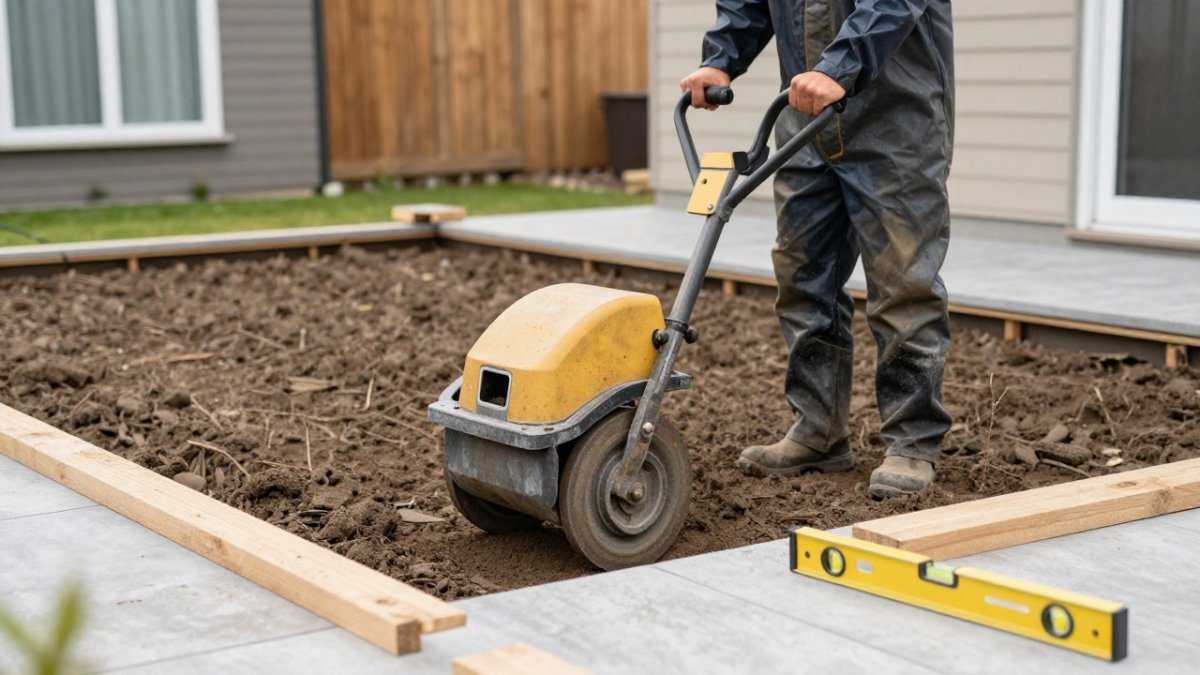
The base is built in compacted layers, each one levelled and checked before the next goes down. Water has to be managed too: the patio needs a consistent fall away from the house so rainwater runs off rather than pooling against the walls. Where the ground does not drain naturally, a proper drainage solution is designed in from the start, not added as an afterthought. If you want the detail, this step-by-step guide to preparing a patio sub-base walks through the layers, and this explanation of the benefits of professional garden drainage installation covers why it matters for longevity.
Slurry Bonding and Fall Away From the House
Ask any installer how they bond the slabs and how they set and check the fall.
Landscaping Contractor Reviews and Portfolios: What Actually Counts
Reviews and portfolios are worth reading, but only if you read them the right way. A wall of five-star ratings tells you little on its own.
Most contractor pages show a rating badge and a handful of testimonials. A more reliable method is to build a small evidence file for each shortlisted firm and compare them side by side.
- Review volume relative to project size. A firm completing large garden schemes may have fewer reviews than one doing small patios, so read volume alongside the scale of work described. Ten detailed reviews of full garden builds tell you more than fifty one-line ratings.
- Recency. Look at the last twelve months of feedback. A firm that was strong three years ago but has gone quiet may have changed hands, lost key staff or taken on too much work.
- Specificity. Reviews that mention ground preparation, drainage, the fall away from the house, site tidiness or how a snag was resolved are harder to fake than praise for being “friendly and professional”.
- Project outcomes. Ask what was built, how long it took and whether the customer would use the firm again. A review that names the project type and the finish is worth more than a star rating alone.
Portfolios need the same scrutiny. A gallery of close-up slab shots shows the material, not the workmanship. Look for wider shots that show the patio in context: the edge restraints, the steps, the drainage outlets, the junction with the lawn and the fall away from the building.
A practical test is to ask each shortlisted firm for two recent referees with patios comparable to yours, then ask those referees three questions: how the ground was prepared, how the site was left each evening, and whether any defects appeared in the first year and how they were handled. The answers reveal more about workmanship than any brochure.
For a sense of the range and finish of completed work, you can see previous projects and judge the workmanship for yourself.
Watch out: a portfolio with no wide shots, no project dates and no named locations is often a stock gallery rather than a record of completed work.
Porcelain Patio Installation Time: What a Realistic Schedule Looks Like
The schedule for a porcelain patio installation depends on access, ground conditions and the complexity of the design, not on the slab count alone. The schedule depends on access, ground conditions and the complexity of the design, not on the slab count alone.
| Stage | What Happens | Typical Duration |
|---|---|---|
| Site set-up and excavation | Marking out, dig-out, waste removal | 1-2 days |
| Sub-base and drainage | Layered sub-base, compaction, drainage runs | 1-3 days |
| Slab laying and bonding | Slurry bonding, laying to fall, cutting | 2-4 days |
| Jointing and finishing | Grouting joints, cleaning, snagging | 1 day |
Typical Duration
Treat any quote that promises a large patio in a single day with caution. A firm that gives you a realistic schedule and explains each stage is usually the one that will do the job properly.
Porcelain Versus Natural Stone: Matching the Material to the Garden
Porcelain and natural stone both make excellent patios, but they suit different gardens and different expectations. Porcelain is manufactured to a consistent colour and finish and is widely used where frost and algae are a concern. Natural stone such as sandstone has a warmer, more varied look, with each slab slightly different, but it needs more care to keep clean and can be more porous depending on the stone.
The right choice depends on the setting. A crisp contemporary terrace often suits porcelain, while a period property or a cottage garden may call for natural stone. Both handle the damp, changeable weather well when laid on a proper base. The material matters, but the installation matters more: a well-laid porcelain patio will outperform a poorly laid stone one every time.
Requesting a Quote for Your Porcelain Patio Project
A good quote request gets you a better quote. Before you contact any firm, note the approximate size of the area, how you want to use the patio, whether there are steps, level changes or drainage concerns, and any access restrictions. The more a firm understands about the site, the more accurate and comparable the quote will be.
Ask each firm to visit, measure and provide a written, itemised quote covering excavation, sub-base, drainage, materials, laying, jointing and waste removal. Ask how long the work will take and what the workmanship guarantee covers. When you are ready to move forward, you can contact us to request a quote for your patio or wider landscaping project.
Choosing a porcelain patio installer comes down to looking past the headline price and judging the parts you cannot see: the ground preparation, the drainage, and the written guarantee behind the work.
Frequently Asked Questions
How do I choose a porcelain patio installer?
Start with proof of insurance and a written scope that names the sub-base depth, drainage falls and jointing method. Ask for two or three recent projects you can visit, and check reviews for comments on punctuality and how snagging was handled. A contractor who explains preparation in detail, rather than just quoting a price per square metre, is usually the safer choice for a porcelain patio.
What should a porcelain patio installation include?
A complete job covers excavation, a compacted sub-base, a correctly graded fall away from the house, slurry bonding or a suitable adhesive bed, and grouting with a flexible jointing compound. It should also include edge restraints, drainage connections where needed, and a clear handover with aftercare advice. Ask for these items in writing so nothing is added later as an extra.
How long does it take to install a porcelain patio?
Most domestic patios take roughly one to two weeks on site, depending on size, access and ground conditions. Preparation usually takes as long as laying the slabs, and wet weather can add days. Ask for a start date and a realistic completion window, plus confirmation of how many people will be on site each day.
Can a landscaping contractor design and build a complete garden?
Yes. Many landscape contractors offer design and build as one service, covering paving, retaining walls, fencing, decking, turfing and planting. This keeps the patio aligned with the rest of the garden and avoids gaps between trades. Ask to see a portfolio of whole-garden projects, not just individual patios, before you commit.

