
Last Updated: November 1, 2026
Quick Summary
The most effective ways to improve driveway curb appeal are choosing a surface that suits your home’s style, adding contrasting edging, framing the entrance with planting, lighting the route and refining gates and boundaries. Start with the surface, since it shapes the whole entrance and determines drainage, ageing and upkeep.
- Choose a surface suited to your home, such as block paving for period homes or porcelain for contemporary ones.
- Use a stone or brick edging strip to sharpen lines and stop grass creeping onto the drive.
- Keep planting low and structured along the edges so it does not block sight lines.
- Add low, shielded path lights along the edges to guide visitors safely and improve safety.
- Match gates and boundary materials to the house and keep their height in proportion.
Table of Contents
- Why Your Driveway Shapes the First Impression of Your Home
- Choose a Driveway Surface That Suits Your Home’s Style
- Use Contrasting Pavers and Decorative Edging
- Frame the Approach with Planting and Low Trees
- Add Lighting Along the Driveway and Entrance
- Refine Gates, Fencing and Boundary Features
- Plan Narrow or Awkwardly Shaped Driveways Carefully
- Book a Design Consultation for Your Driveway Project
- Frequently Asked Questions
Why Your Driveway Shapes the First Impression of Your Home
Your driveway is the first thing visitors see, and often the first thing you see every day. For many homes, it covers more of the front view than the house itself. That makes it one of the most effective places to improve driveway kerb appeal, and the changes often pay off in how the whole property looks.
Good driveway design is about balance. A clean surface, sharp edges, good lighting and planted borders all work together. This guide from Finescape Landscaping & Paving Ltd walks through seven practical ways to improve driveway kerb appeal, starting with the surface itself.
Choose a Driveway Surface That Suits Your Home’s Style
The right surface sets the tone for the whole entrance. A traditional brick or stone house suits a classic block paving pattern, while a contemporary property often looks best with clean-lined porcelain or a simple concrete finish. But the surface you choose also determines how the drive drains, how it ages and what it costs to keep looking sharp, so it is worth comparing the main options side by side rather than picking from a catalogue photo.
The main surface options compared
- Block paving (clay or concrete). A classic choice for period and family homes. Clay blocks are a traditional choice for period and family homes.
- Natural stone (sandstone, limestone, granite). Suits larger and period properties and country homes. It is a premium material suited to larger and period properties and country homes.
- Porcelain. A modern option with a consistent finish that suits contemporary homes.
- Gravel and resin-bound gravel. Gravel gives an informal look as a loose surface, while resin-bound gravel offers a firm, consistent surface with a gravel appearance.
- Concrete and decorative concrete. Patterned or exposed-aggregate finishes are options for a more decorative look.
- Tarmac. The cheapest hard surface and quick to lay, but it looks functional rather than decorative and can soften in very hot weather.
Drainage and planning: the British specifics
In England, most front gardens are classed as permeable if the surface is porous or drains to a permeable area, and a permeable surface of any size may not need planning permission (Guidance on the permeable surfacing of front gardens). If you are laying an impermeable surface such as block paving or tarmac over an area larger than five square metres, you will usually need planning permission unless you direct run-off to a permeable area within your boundary (Guidance on the permeable surfacing of front gardens). Check with your local planning authority before work starts, because rules and conservation areas vary.
On a slope, water needs somewhere to go. A common pattern is a channel drain or Aco drain across the entrance, connected to a soakaway or surface water system, rather than letting water run onto the road. This is where a properly designed sub-base and falls matter more than the surface itself.
Cost tiers to plan around
Pricing depends on quantity, dates and delivery, so ask for a written quote based on your own measurements and site access, as a narrow or sloping site can change the labour and drainage work significantly. Current prices are available from Finescape Landscaping & Paving Ltd’s website.
Ask to see samples in daylight beside your house before you decide. A paver that looks right in a showroom can look very different against your brickwork or render.
If you are planning a larger project, our driveway and patio installation service covers many surfaces, and you can see more driveway paving ideas that transform a home entrance for inspiration.
The main surface options differ in look, cost and upkeep, as summarised below.
| Surface | Best for | Key difference |
|---|---|---|
| Block paving (clay or concrete) | Period and family homes | Classic traditional finish |
| Natural stone | Larger, period and country homes | Premium material |
| Porcelain | Contemporary homes | Consistent modern finish |
| Gravel and resin-bound gravel | Informal or firm surfaces | Gravel look; resin-bound is firmer |
| Concrete and decorative concrete | Decorative looks | Patterned or exposed-aggregate finishes |
| Tarmac | Functional drives | Cheapest and quick to lay; can soften in heat |
Use Contrasting Pavers and Decorative Edging
Contrast is one of the simplest ways to add depth and texture. A border of darker pavers around a lighter main field, or a stone edging strip along the kerb, draws the eye and gives the driveway a finished look.
Decorative edging also hides the join between the driveway and the lawn or planting. Without it, edges can look untidy within a few seasons as grass creeps in. A stone or brick border keeps the lines sharp and makes maintenance simpler.
Keep the colours within a small range. Two or three tones usually look more deliberate than a busy mix of finishes.
Frame the Approach with Planting and Low Trees
Planting softens hard surfaces and makes the entrance feel welcoming. Low, structured planting along the edges works well, and a single small tree can anchor the view from the road.
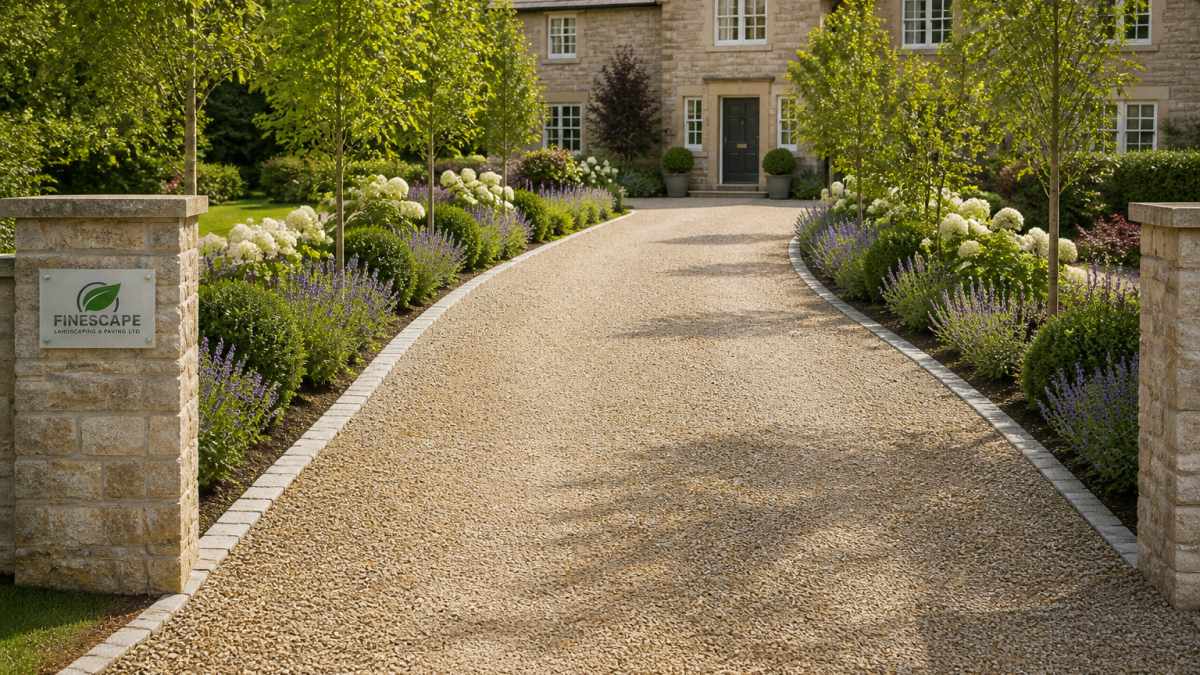
Choose plants that will not block sight lines or spill over onto the drive. Perennials, low shrubs and ornamental grasses are good options for borders. Keep taller specimens well back from the edge so they do not crowd the entrance.
Mulch the beds with bark or gravel to keep the look neat and reduce weeds. Planting does not need to be elaborate to make a clear difference.
Add Lighting Along the Driveway and Entrance
Lighting changes a driveway after dark, when many people see it most often. Low path lights along the edges guide visitors safely to the door, and an uplight on a feature tree or the front wall adds a welcoming glow.
Lighting also improves safety. Keep fittings low and shielded so they light the surface without glaring into passing traffic or neighbouring windows.
For ideas on what works well, see our guide to modern driveway lighting ideas for 2026. Spacing and wiring are easiest to plan before the surface goes down, so decide on lighting early.
Refine Gates, Fencing and Boundary Features
Gates and boundaries frame the entrance. A well-chosen gate sets the style for the property, and a clean fence or wall gives the driveway a defined edge.
Match the materials to the house. Timber suits a rural setting, while powder-coated metal or a slim contemporary design often suits a modern home. Keep the height in proportion so the entrance feels open rather than closed off.
A finish that matches the rest of the property helps the entrance look cohesive. Small details like these are often what people notice first.
Plan Narrow or Awkwardly Shaped Driveways Carefully
Small, narrow or sloping driveways need a different approach. Strong lines and simple patterns usually work better than fussy designs, because busy layouts can make a tight space feel cramped. But the bigger issues on an awkward site are practical: how vehicles turn, how water drains and how people walk safely from the car to the door.
Vehicle access and turning
Measure the actual turning circle of the cars that will use the drive, not just the width of the vehicle. A common pattern is to widen the apron at the entrance so a car can swing in without clipping the gateposts, then narrow the drive further back. On a long, narrow plot, a slight curve or a widened parking bay at the end can make the space feel more generous and easier to use. Check that doors can open fully without stepping onto a border or into a wall.
Slopes and drainage
A sloping drive is the most common awkward site. Water gathers at the lowest point, so plan falls and a channel drain before the surface goes down. On a steep slope, consider a stepped or terraced layout with retaining walls, or a surface with good grip such as textured stone or resin-bound gravel. Avoid smooth porcelain on a steep wet slope unless it has a verified slip rating.
Safety and accessibility
Keep a clear pedestrian route from the car to the front door, ideally separate from the vehicle path. Good lighting at changes of level, steps and the door itself reduces trips. If anyone in the household has limited mobility, a gentle ramp with a handrail and a firm, level landing at the door makes a real difference. Avoid loose gravel on the pedestrian route.
Shared access and boundaries
If the drive is shared, check who owns the surface and who is responsible for drainage and repair before you change anything. A well-defined edge, such as a stone border or a low wall, helps mark the boundary and keeps the shared surface looking tidy.
Making a tight space look bigger
Use a simple, consistent paving pattern and keep the colour range narrow. Run the paving in the same direction as the approach so the eye is drawn to the house. Keep planting low and structured at the edges, and use lighting to define the route rather than to fill the space with fixtures.
On an awkward site, spend the design budget on drainage, levels and turning space first. The surface and planting look better when the practical layout is right.
If the layout is tricky, contact us for advice on your specific site before committing to a design.
Book a Design Consultation for Your Driveway Project
Planning the steps above in the right order helps the project run smoothly. Surface, edging, planting, lighting and boundaries all affect each other, so a single plan usually works better than a series of separate changes.
A design consultation lets you see how the options fit your property, your budget and your daily use. Pricing depends on quantity, dates and delivery, so ask for a written quote based on your own plans. For more about our approach, get in touch with the Finescape team to talk through your driveway project.
Frequently Asked Questions
How can I make my driveway look like new?
Start by cleaning the surface thoroughly. Then repair cracks, reset any loose or sunken pavers and reinstate the edges. Where the surface is worn beyond repair, consider re-laying it in a new material. Finescape Landscaping & Paving Ltd can assess your driveway and advise on the most cost-effective route. Pricing depends on quantity, dates and delivery, so please contact us for a quote tailored to your property, and see Finescape Landscaping & Paving Ltd’s website for current prices.
What adds kerb appeal to a driveway?
The most effective changes are usually a coordinated surface material, clean and defined edging, planting that softens hard lines and lighting that makes the entrance visible after dark. Together these create a sense of arrival and make the approach to the home look considered. Pairing a driveway with matching gate and boundary finishes also helps the whole frontage read as one design rather than separate elements.
Can a new driveway improve a home’s kerb appeal?
Yes. A driveway is one of the largest visible areas of a front garden, so its surface, colour and condition strongly influence first impressions. A well-designed driveway in a material that suits the property’s style can make the home look better cared for. The result depends on good groundwork and drainage, because a surface that sinks, cracks or pools water will undermine any visual improvement.

